

How To Install Solidity On Windows
Solidity back up for Visual Studio code


Solidity is the linguistic communication used in Ethereum to create smart contracts, this extension provides:
- Syntax highlighting
- Snippets
- Compilation of the current contract (Press F1 Solidity : Compile Current Solidity Contract), or F5
- Compilation of all the contracts (Press F1 Solidity : Compile all Solidity Contracts), or Ctrl + F5 or Cmd + F5
- Lawmaking completion for all contracts / libraries in the current file and all referenced imports
- Default projection structure (solidity files needs to be in the
src/directory, and libraries in thelib/directory). Libraries will follow the aforementioned structure. - Compilation supporting EIP82 (dappfile and dependency packages)
- Support for dissimilar solidity versions (Remote and local)
- Code generation using Nethereum, it includes currently the default template for Nethereum service, dtos generation. (Open 'contractName.json' after compilation from the bin folder. Press F1 and press Solidity: Code generate from compilation output..) Auto generation of Nethereum files on compilation
- Linting using Solhint or Ethlint
Instructions
Using a different version of the solidity compiler
Sometimes y'all may want to use a different compiler than the ane provided. You can notice all the different versions in the solc-bin repository https://binaries.soliditylang.org/
Currently nosotros support 4 means supported to employ a different version of the solidity compiler. Remote, Local, NodeModule and Embedded
Yous can change the compiler, in your user settings or workspace settings.
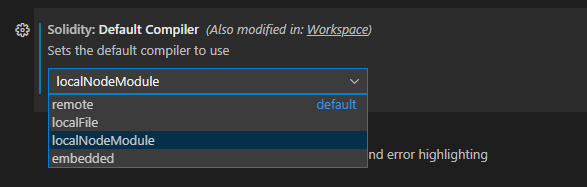
Remote download
When selecting remote download the compiler gets downloaded from the solc-bin repository.
You will need to change the following user setting, with the version required, for case 'latest' or 'v0.4.iii+commit.2353da71', for your workspace user setting (electric current projection) or global user setting (all projects)
"solidity.compileUsingRemoteVersion" : "latest" 
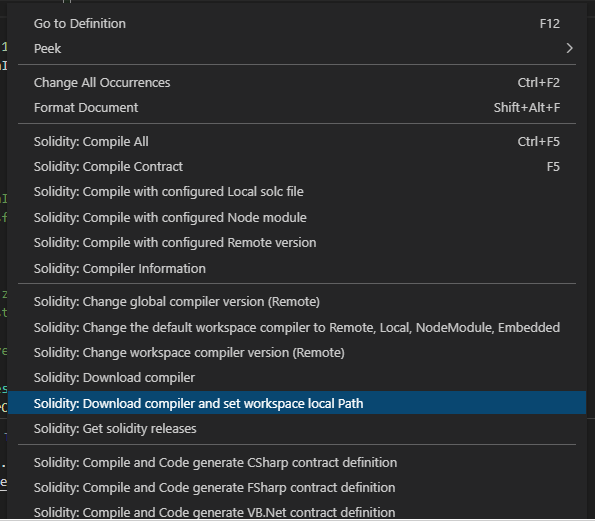
Y'all tin can merely alter this setting using the context menu:


Using a Local file
If you desire to proceed a compiler version locally, you can download the compiler from https://binaries.soliditylang.org/ and change your user settings to use this.
"solidity.compileUsingLocalVersion" : "C:\\Users\\JuanFran\\Downloads\\soljson-v0.4.15%2Bcommit.bbb8e64f.js" The simplest way to download a compiler is to use the context menu, this will download your desired version at the root of the project and configure your workspace accordingly.
Npm / node installation
Another option, is to use the solc npm package in your project, if this is enabled it will try to notice the compiler in your configured node_modules at root.
You can install solc using npm at the root of your project as follows.
npm install solc The default module package is "solc", but you may want to use other node module containing a compiler, this tin can be configured in the settings: 
Compiling a specific contract using a different compiler than the default one.
There might be scenarios, that yous want to use a different compiler for a specific file, using i of the other configured compilers.


ERC, ERC drafts and Smart contracts snippets / reference
It is pretty difficult sometimes to find interfaces or information near an EIP (ERC) or specific libraries to simply get started working with Solidity. The solidity extension now includes ERC approved and most drafts (wip) to aid get you started.
Just blazon erc and select the erc example or interface you want.


Smart contract projection interfaces
In a similar to fashion to ERCs and as we work towards to more interoperable smart contracts, existence able to quickly examine those interfaces that you lot want to integrate is a time saver.
The current release includes the interfaces for Uniswap V2 (to get started), just blazon uni to listing them all. 

Note: If an ERC or your projection is not included, please create a pull request. Note: Only established projets will be included.
Compiler optimization
Optimize for how many times you intend to run the lawmaking. Lower values will optimize more for initial deployment cost, higher values will optimize more than for high-frequency usage. The default value is 200. "solidity.compilerOptimization": 200
Project construction and Remappings
OpenZeppelin (Default)
If y'all're using @openzeppelin/contracts, the OpenZeppelin Contracts volition exist establish in your node_modules folder, so the user settings will be the following, bold your solidity project is at root.
"solidity.packageDefaultDependenciesContractsDirectory": "", "solidity.packageDefaultDependenciesDirectory": "node_modules" If you have a deeper structure, like
Solution └───solidity_project │ │ | │ xx.sol │ └───node_modules │ └───Nethereum_Project | │ xx.cs | │ yy.cs | └───Web3Js_Project | │ xx.js | │ yy.js Your user settings configuration will need to represent the total structure:
"solidity.packageDefaultDependenciesContractsDirectory": "", "solidity.packageDefaultDependenciesDirectory": "solidity_project/node_modules" Dappsys (onetime ERC)
The project / library dependency structure can apply the DappSys library model, this was the default manner before equally it was part of an ERC:

Libraries volition have the same name as their folder they are included. Solidity files volition be in the 'src' binder. Libraries volition be included in the 'lib' folder.
Currently there is no name alien resolution, so the first library constitute matching a proper name, will be the first one used.
The user settings for this structure is:
"solidity.packageDefaultDependenciesContractsDirectory": "src", "solidity.packageDefaultDependenciesDirectory": "lib" Remappings
Another option is to use remappings to ascertain where your dependency libraries are, this can be achieved using the settings or creating a "remappings.txt" file in the root binder. For more info on remappings check the solidity documentation here https://docs.soliditylang.org/en/latest/path-resolution.html?highlight=remapping#import-remapping
If you want to use the solidity user settings for your workspace / global remappings, please include them in the solidity.remappings
"solidity.remappings": [ "@chainlink/=/Users/patrick/.brownie/packages/smartcontractkit/chainlink-brownie-contracts@0.ii.2", "@openzeppelin/=/Users/patrick/.brownie/packages/OpenZeppelin/openzeppelin-contracts@four.3.ii" ] Or if yous desire to include them in the remappings.txt file, but put the file at the root of your projection folder. Note: These will override your solidity settings if included 
Platform specific remappings
In that location are situations when cross-platform paths are needed, in this example yous tin can use the solidity.remappingsWindows or solidity.remappingsUnix settings.
"solidity.remappingsWindows": [ "@openzeppelin/=C:/Users/<USERNAME>/.brownie/packages/OpenZeppelin/openzeppelin-contracts@four.4.2" ], "solidity.remappingsUnix": [ "@openzeppelin/=/Users/<USERNAME>/.credibility/packages/OpenZeppelin/openzeppelin-contracts@iv.four.2" ] Code completion
Autocomplete is by and large supported beyond for smart contracts, structs, functions, events, variables, using, inheritance. Autocomplete should happen automatically or printing Ctrl+Space or Command+Infinite in areas like "import".

Auto compilation and error highlighting
Car compilation of files and error highlighting can be enabled or disabled using user settings. Also a default filibuster is implemented for all the validations (compilation and linting) as solidity compilation can be slow when you have many dependencies.
"solidity.enabledAsYouTypeCompilationErrorCheck": true, "solidity.validationDelay": 1500 Linting
There are two linters included with the extension, solhint and solium / ethlint. You can chose your preferred linter using this setting, or disable it past typing ''

Solhint
To lint Solidity code you can use the Solhint linter https://github.com/protofire/solhint, the linter can be configured it using the following user settings:
"solidity.linter": "solhint", "solidity.solhintRules": { "avoid-sha3": "warn" } This extension supports .solhint.json configuration file. It must be placed to projection root directory. Afterwards whatever changes in .solhint.json it will exist synchronized with electric current IDE configuration.
This is the default linter at present.
NOTE: Solhint plugins are non supported yet.
Solium / Ethlint
Solium is also supported by the extension https://github.com/duaraghav8/Solium, yous can configure it using the following user settings:
"solidity.linter": "solium", "solidity.soliumRules": { "quotes": ["error", "double"], "indentation": ["error", 4] }, Formatting using Prettier and the Prettier Solidity Plugin
Formatting is provided thanks to the Prettier plugin for Solidity for more info check https://prettier.io/ and https://github.com/prettier-solidity/prettier-plugin-solidity
Formatting uses the default formatting settings provided past prettier, if you want to provide your custom settings create a .prettierrc file every bit follows
{ "overrides": [ { "files": "*.sol", "options": { "printWidth": 80, "tabWidth": 4, "useTabs": true, "singleQuote": false, "bracketSpacing": truthful, "explicitTypes": "ever" } } ] } If you would like to format on save, add together this entry to your user / workspace settings:
"editor.formatOnSave": truthful
Code generation Nethereum
The extension integrates with the Nethereum lawmaking generator to create Contract integration definitions. You tin can either generate the api for a single contract, all compiled contracts, or automatically every time y'all compile a smart contract solidity file.
The simplest style to code generate a the contract definition for a smart contract is to right click and select the project / language you require:

Automated code generation and the Nethereum Code generation settings file.
If you want to automatically code generate your api, every time to you compile, y'all tin can do this creating a file "nethereum-gen.settings" at the root of your project, with the following contents. You lot can create it automatically using the context card too.
{ "projectName": "Solidity.Samples", "namespace": "Solidity.Samples", "lang":0, "autoCodeGen":truthful, "projectPath": "../SoliditySamples" } "lang" indicates what linguistic communication to generate the code, 0 = CSharp, 1 = Vb.Internet and iii = FSharp
The "projectName" and "namespace" settings volition be used for the manual code generation also.
Employ the "projectPath" to ready the relative path of your .Net projection, this allows to work in a "solution" manner then you lot tin can work as an both in Visual Studio Code and Visual Studio (Fat) with your .Internet project, or two windows of vscode.
Abi contract code generation
You may have only the abi of a smart contract and want to lawmaking generate the contract definition. Just create a file containing the abi, with the extension .abi and another with the .bin content (if needed) and use this context carte.

Single smart contract manual code generation
To code generate the Nethereum contract api from a single smart contract, you need to select the compiled "json" output file from the "bin" binder, printing F1 and offset typing "Solidity: Lawmaking generate" and select what linguistic communication you want to generate for the current selected file.
All smart contracts manual code generation
To lawmaking generate the Nethereum contract for all smart contracts already compiled, just press F1, and start typing "Solidity: Code generate" and select the pick for all contracts for your desired language.
(Depricated) Assay of smart contracts with Mythx
Mythx analysis tool, has been moved to its own stand solitary extension, please download it hither.
Contributing / Issues / Requests
For ideas, bug, additions, modifications delight raise an issue or a pull asking at https://github.com/juanfranblanco/vscode-solidity/ and send a message on gitter at https://gitter.im/vscode-solidity/Lobby or https://gitter.im/Nethereum/Nethereum to become an instant notification.
Credits
Many thank you to:
Christian Reitwiessner and the Ethereum team for Solidity https://github.com/ethereum/solidity
Raghav Dua and everyone that contributed to Solium, the solidity linter, and the solidity parser.
Ilya Drabenia for creating the Solhint linter and the integration into the extension.
Nexus team for the original cosmos of the dappfile to construction contracts in projects https://github.com/nexusdev/dapple.
Fellow Gunderson for contributing the initial integration of solium https://github.com/juanfranblanco/vscode-solidity/issues/24, the initial server and error mappings.
Mattia Richetto, Klaus Hott Vidal and Franco Victorio for creating the Prettier Solidity plugin and of course all the developers of Prettier. Please become to https://github.com/prettier-solidity/prettier-plugin-solidity for help and collaboration.
Bram Hoven for starting the multiple package dependency support for different environments (node_modules, lib)
Piotr Szlachciak for refactoring the syntaxes
James Lefrere for further refactoring the syntaxes.
Forest Fang for providing the implementation of the "Get to definition", allowing y'all to navigate to structs, contracts, functions calls, etc
Bernardo Vieira for adding the adequacy to read the solium settings from a file in the workspace root directory.
Mirko Garozzo and Rocky Bernstein for the piece of work on creating and integrating the Mythx api to analyse smart contracts (OBSOLETE NOW)
Nick Addison, Elazar Gershuni, Joe Whittles, Iñigo Villalba, Thien Toan, Jonathan Carter, Stefan Lew, Nikita Savchenko, Josh Stevens, Paul Berg for their contributions.
Sebastian Bürgel for keeping reminding me of the offline installation suppport
David Krmpotic and Ralph Pichler for the original Sublime extension https://github.com/davidhq/SublimeEthereum
Anybody for their back up and feedback!
Source: https://marketplace.visualstudio.com/items?itemName=JuanBlanco.solidity
Posted by: lovellequithere1991.blogspot.com
0 Response to "How To Install Solidity On Windows"
Post a Comment